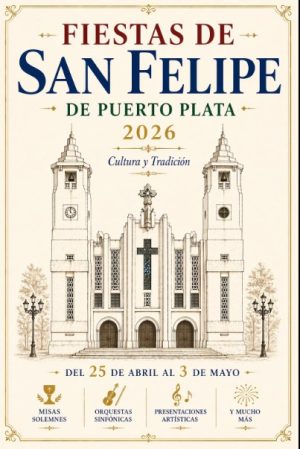
“excerpt in progress”
April 25, 2026


Wednesday, April 29 planned program in honour of International Dance Day. Performances were to be presented by (see next slides): 
Academia de las Danzas Grandales (Grandales Dance Academy) a local dance school under the direction of Maestra Gertrudis Grandales Pérez focusing on various dance styles. 
Sacred Elements of the Cibao Tribe was to be a performance honouring the Taino heritage and spiritual richness of the culture. Rhythm, tradition, and expression connects past to the present showing art as a language of identity. 


Thursday, May 30 planned program included Salomé: Aqui a la Sombra (Salomé: Here in the Shade) a stage production presented by Directorate of Fine Arts and the Dominican Traveling Theatre 
In celebration of International Jazz Day two performers were set to perform: Stefanía Tomarelli from Chile, followed by Natalija Tumpej from Slovenia (see music clip below). They were to perform under the direction of guitarist, Juan Guivin from Peru. 
Friday, May 1st the Dominican National Ballet was to present the ballet Salomé, Alma de Patria (Soul of the Homeland) 
” Sinestesia” (Synesthesia) a contemporary ballet piece choreographed by Pablo Pérez for the Dominican National Dominicano. Inspired by the neurological phenomenon in which the stimulation of one sense automatically and involuntarily triggers an experience in another sense, “synesthetes” might “see” music as colours, “taste” words or perceive letters and numbers as specific, unchanging hues. This production explores the blending of the senses, merging dynamic body movements, vivid costumes, and musicality into a unified performance. 
This amazing artist trained as a singer at the University of Music and Performing Arts in Vienna, Austria. To learn more about her, click on the link: https://ritmo.com.do/nathalie-pena-comas/ 
Saturday, May 2 Orquesta Filarmónica de Santo Domingo (Santo Domingo Philharmonic Orchestra) was to perform under the direction of conductor and founder, Maestro Amaury Sánchez. 
Sunday, May 3 there was to be a performance by Ballet Folklórico Nacional Dominicano (the Dominican National Folkloric Ballet). Formed in 1981 the group serves to preserve, transmit, and promote the artistic and cultural expressions of the country. It develops a repertoire of choreographic pieces based on Dominican myths, customs, stories, legends, and landscapes, and creating spaces to perform. 
May 1 Sadly an announcement was made that due to extremely heavy rains and subsequent flooding on the north coast the planned performances would be cancelled. What a shame…..
The Fiesta Patronal (FestivalPatronal) is a yearly celebration in Christian influenced countries. San Felipe Apóstol (Saint Philip the Apostle) is the patron saint of Puerto Plata and his feast day of May 3 is an annual celebration. Daily mass and a variety of performances are held in Parque Central Independencia (Independence Central Park) during the entire week of April 25 to May 3.
It is possible that the colonial explorers from Spain dedicated the settlement to Saint Philip who is a traditional patron for maritime communities. This dedication would have been in the Spanish tradition.

Each year the festival opens with a Eucharistic Mass when the young woman chosen to be Queen of the Festival is crowned. This crowning is not a beauty pageant but a tribute to the rich history of the north coast that began with Cristóbal Colón’s (Christopher Columbus’) second voyage in 1493.
A community of thirty-nine sailors were the first residents of La Isabella (named in honour of Queen Isabella of Castile and Aragon). Located forty-two kilometers west of what is now Puerto Plata it was abandoned just three years later in 1496. The ruins of La Isabela continue to exist as an Archaeological Park with four areas: the castle (main town centre), granary, quarry, and port.
Before La Isabella was abandoned, Columbus would explore the north coast of Hispanola entering the bay January 11, 1493. In time this would become Puerto Plata.
Nine years later (1502), under the direction of Columbus, Nicolas de Ovando established a staging point for galleons on their way back to Spain. For one hundred and four years the port would be the best from which to export bananas and fruit to Europe.
By 1606 smuggling had taken hold to such a degree that King Philip III ordered Governor Antonio de Osorio to de-populate western (now Haiti) and northern Hispanola, this was known as the Devastaciones de Osorio (The Devastations of Osorio) or Depopulations of Hispaniola.
One hundred and thirty years later the Cabildo of Santiago, Dominican Republic (municipal council) felt that the north coast was essential for security and royal service. Petitions in 1715 and 1732 were filed to secure Spanish domain. Repopulation was formally started in July of 1736 with colonists from surrounding areas ie Santiago and La Vega arriving followed by families from the Canary Islands. unity.
Since 1970, the selection of the festival queen and her court honours Queen Isabella of Castile and Aragon. The coronation of the young woman chosen as queen represents special significance for the people of Puerto Plata. It serves as a celebration of identity, elegance, and commitment to the roots of Puertoplateños’ faith, culture, and profound
Leave a Reply